Support

Matadero Madrid

About

Matadero Madrid is one of the largest and most dynamic cultural centers, located in the Arganzuela district of Madrid, Spain. The uniqueness of this place lies in its past: the complex occupies the site of the former city slaughterhouse and market built in the early 20th century. Today, these historic industrial buildings in Neo-Mudéjar style have been completely transformed into an avant-garde space for creativity, art, and leisure.

Matadero Madrid is a true "city of culture," where many different disciplines are united under one roof. It houses the Cineteca cinemas, specializing in documentary and independent film, exhibition halls, theater venues, the Central de Diseño design center, as well as "The Reader's House" (Casa del Lector), dedicated to literature. This interdisciplinary approach allows for festivals, concerts, lectures, and workshops, attracting a very wide audience.

A visit to Matadero is an opportunity to experience Madrid's modern creative life in an unusual historical setting. The space is constantly evolving, offering new projects and exhibitions, making it one of the most interesting and visited attractions in the capital for both tourists and locals. Here, industrial heritage is harmoniously combined with cutting-edge cultural initiatives.
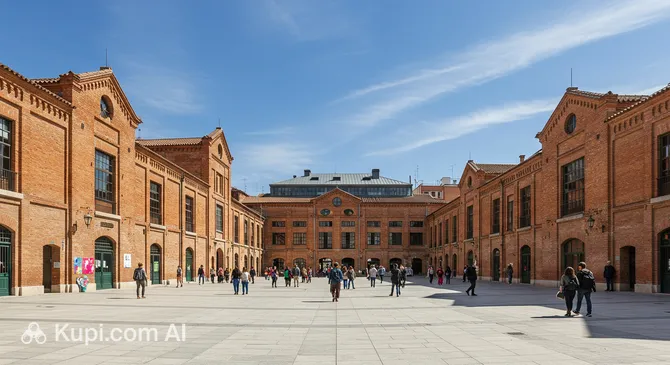
Matadero Madrid. Illustration.
Source: Kupi.com AI

Traveler photos:

Contacts

To plan your visit to the Matadero Madrid cultural center and find up-to-date information on exhibitions, events, and opening hours, it is recommended to consult official sources. The cultural center is located at: Plaza de Legazpi, 8, 28045 Madrid, Spain.

How to contactContact
AddressPl. de Legazpi, 8, Arganzuela, 28045 Madrid, Spain
Phone number+34 913 18 46 70
Websitewww.mataderomadrid.org

What to Do

A visit to the Matadero Madrid cultural center is an opportunity to immerse yourself in a kaleidoscope of cultural events and experiences. Here, you can watch independent and documentary films at the modern Cineteca cinemas, visit a film set, or explore an extensive film library. The space regularly hosts contemporary art exhibitions, theatrical productions, concerts, and festivals, making it one of the main magnets for the creative community of Madrid.

Each pavilion in the complex has its own unique specialization, offering visitors a variety of activities. For example, Naves del Español hosts theatrical performances, Central de Diseño organizes design-focused exhibitions, and Casa del Lector is the center for literary events. Additionally, the complex features a spacious 4,000-square-meter exhibition gallery where large-scale art projects are showcased.

Matadero Madrid consists not only of indoor pavilions but also a large open-air space, including Matadero Street and Plaza. This is where open-air concerts, fairs, and various performances take place, creating a lively and dynamic atmosphere. Workshops, educational programs, and interactive projects are regularly organized for families with children and young people, making this an ideal place for educational leisure and creative development.

Getting There

The Matadero Madrid cultural center is conveniently located in the Arganzuela district, making it easily accessible for visitors. The simplest and fastest way to get here is by using the metro. The nearest station, Legazpi, served by lines 3 and 6, is just a few minutes' walk from the complex. This is an ideal option for those looking to avoid city traffic and quickly reach the heart of cultural events.

In addition to the metro, Matadero can be reached by numerous city buses, with stops located near Plaza de Legazpi. An extensive network of bus routes allows you to reach the attraction from almost any point in Madrid. You can also use taxi services, which are particularly comfortable for small groups or families. A taxi ride from the city center will take about 10-15 minutes, depending on the traffic situation.

If you are planning to travel by car, it is worth noting that while parking is available in the vicinity, finding a free spot on weekends and public holidays can be difficult due to the complex's high popularity. To avoid inconvenience, it is recommended to prioritize public transport, especially during major festivals and events.

Nearest city: Madrid

History & Facts

The history of Matadero Madrid is a vivid example of how a utilitarian industrial space can find new life and become the heart of a city's cultural scene. The complex was built between 1908 and 1928, designed by the renowned Spanish architect Luis Bellido. Originally, its purpose was to serve the needs of the growing capital: the city's main slaughterhouses and livestock market were located here.

Even as an industrial site, the complex possessed significant architectural value from the very beginning. The buildings were designed in an industrial modernist style with Neo-Mudéjar elements, making them one of the most interesting examples of early 20th-century industrial architecture in Madrid. Luis Bellido managed to combine functionality, rationality, and aesthetic simplicity in the project, creating a thoughtful and harmonious ensemble.

At the end of the 20th century, after the slaughterhouse closed, a new chapter in the history of this place began. The Madrid City Council initiated a large-scale project to restore and transform the complex into a center for contemporary art. Leading architectural firms, such as Leticia López de Santiago and Josemaría de Churtichaga + Cayetana de la Quadra-Salcedo, were brought in for this ambitious task. They treated the historical heritage with care, preserving the unique appearance of the buildings while adapting them for new cultural functions.

As a result of this transformation, Matadero Madrid turned into an avant-garde space for creativity, opening its doors to the public in 2007. Today, it is not just an attraction but a dynamically developing "city of culture," hosting exhibitions, festivals, theatrical productions, and film screenings. The successful reconstruction has made Matadero a model example of industrial zone revitalization and one of the most visited cultural venues in Spain.

Time Needed

When planning a visit to the Matadero Madrid cultural center, keep in mind that the duration of your stay depends directly on your interests. For a general introduction to this unique space, a walk through its grounds, and a quick look at the open areas and pavilions, 2–3 hours is usually sufficient. During this time, you can get a feel for the architecture of the former industrial complex and soak up its creative atmosphere.

However, if you want to dive deeper into the cultural life of Matadero, you should set aside significantly more time—from half a day or longer. A full visit might include watching a film at the Cineteca cinema, visiting several exhibitions in different pavilions, watching a theatrical production, or participating in one of the many events. To plan your day as effectively as possible, it is recommended to check the event schedule on the center's official website in advance.

Working Hours

The Matadero Madrid cultural center is open year-round, but it does not have a single set of opening hours, as they depend on each specific pavilion and event. Generally, the open spaces of the complex are available for walks daily from 9:00 AM to 10:00 PM. However, the exhibition halls, cinema, and theater venues have their own schedules, which may vary. For instance, exhibitions are often closed on Mondays.

Before your visit, it is strongly recommended to check the current event schedule and opening hours for the venues you are interested in on the official Matadero website. Attending many events, such as plays, film screenings, or concerts, may require advance ticket purchase. The on-site ticket office usually operates from Tuesday to Sunday in the afternoon, but buying tickets online will help save time and guarantee a seat.

9:00 – 22:00

Nearby

A visit to the Matadero Madrid cultural center is just the starting point for exploring the attraction-rich Arganzuela district and its surroundings. A stroll through the nearby streets will allow you to dive deeper into the atmosphere of modern Madrid, where an industrial past is harmoniously interwoven with the art, culture, and daily life of the capital of Spain.

The location of Matadero is ideal for combining a visit to the cultural center with exploring other iconic sites. Within walking distance or a short public transport ride, you will find world-famous museums, historical monuments, and charming corners of the city, each of which will uniquely complement your travel impressions.

NameDistance
Museo Reina Sofía1.8 km
Casa de Campo2 km
Prado National Museum2.5 km
Inclán Brutal Bar2.6 km
Calle 365 Madrid2.6 km
Plaza Mayor2.7 km
Rosi La Loca2.7 km

Have you reached the end of the page?

So the route has been studied inside and out