Support

Prado National Museum

About

The Prado National Museum is not just a museum, but a true treasure house of world art located in the heart of Madrid. As one of the most significant and visited art museums in the world, the Prado is rightfully considered a cultural gem of Spain. Visiting this site is a unique opportunity to travel through the centuries and witness the brilliant creations of the greatest European masters.
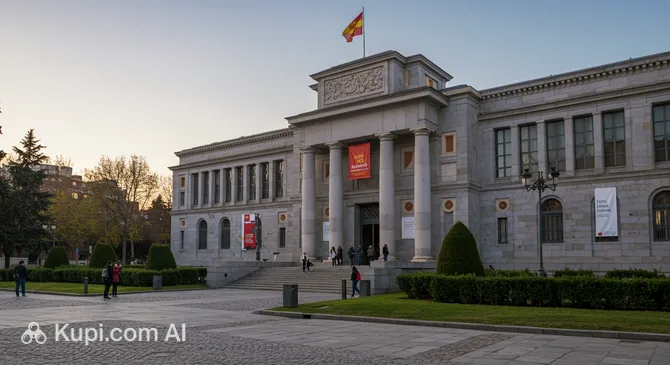
Prado National Museum. Illustration.
Source: Kupi.com AI

Traveler photos:

The core of the museum's collection was formed from the private collections of Spanish monarchs, which defined its unique character. Today, the collection includes about 7,600 paintings, 1,000 sculptures, and thousands of prints, although only about 1,300 of the most outstanding works are on permanent display. The Prado boasts the world's most complete collection of works by Spanish geniuses such as Diego Velázquez, Francisco Goya, and El Greco. Alongside them, you can see masterpieces by Flemish, Italian, and German artists, including Bosch, Titian, Raphael, and Dürer.

The museum building itself is an architectural monument. Designed at the end of the 18th century by architect Juan de Villanueva in a strict Neoclassical style, it was originally intended for the Natural History Museum. Interestingly, the name "Prado," which translates from Spanish as "meadow," was given to the museum because of the parkland where it was built. Opened to the public in 1819 as the Royal Museum of Painting and Sculpture, it remains a mandatory stop for every art lover visiting Madrid.

Contacts

To plan your visit to the Prado National Museum, you will need its exact address in Madrid. The museum is located at: Paseo del Prado, s/n, 28014, Madrid. Sometimes the address of one of the entrances, Calle de Ruiz de Alarcón, 23, is used as an additional reference point.

Since opening hours, ticket prices, and information about temporary exhibitions can change, we strongly recommend finding the official museum website via any search engine just before your visit. This is the most reliable way to get up-to-date information and make your visit as smooth as possible.

How to contactContact
AddressRetiro, 28014 Madrid, Spain
Phone number+34 913 30 28 00
Websitewww.museodelprado.es

What to Do

A visit to the Prado National Museum is an immersion into the world of fine art, where every room opens a new chapter in the history of painting. The primary activity here is, of course, exploring the rich collection of masterpieces. You can see Velázquez's famous "Las Meninas," Bosch's enigmatic "The Garden of Earthly Delights," and Goya's powerful "Black Paintings." Beyond paintings, the exhibition includes unique sculptures, ancient frescoes, drawings, and decorative arts ranging from antique furniture and ceramics to precious jewelry.

The museum's collection is so vast that it covers the work of great masters from many different countries. It features the most complete collections of Spanish artists like El Greco, Velázquez, and Goya, as well as essential works from the Italian and Flemish schools. You will see canvases by Titian, Rubens, Dürer, and many other geniuses. The first painting transferred to the museum's collection back in 1829 was Velázquez's "Christ Crucified," and the collection has been constantly growing ever since.

Furthermore, life at the museum never stands still. The Prado regularly organizes temporary exhibitions dedicated to both individual artists and entire art movements. For example, past successful exhibitions have featured the works of Titian and Picasso. Therefore, every visit can offer new experiences, even if you have been to Madrid before. Be sure to check the schedule of special events before your visit—you might be able to attend a unique lecture or an exclusive exhibition that will make your journey through the world of art in Spain even more memorable.

Getting There

The Prado National Museum is located in the very heart of Madrid, making it very convenient to visit. It sits on the famous Paseo del Prado boulevard, neighboring other iconic spots such as Retiro Park and the Royal Botanical Garden. Thanks to this prime location, reaching the main treasure house of art in Spain is quite easy.

The simplest and fastest way to get to the museum is by using public transport. The nearest metro stations to the Prado are Estación del Arte (formerly Atocha) on Line 1 and Banco de España on Line 2. From both stations, the museum is a 10–15 minute walk. Additionally, numerous city buses stop near the museum, including routes 10, 14, 27, 34, 37, and 45; the stop is called Museo del Prado - Jardín Botánico.

If you are staying in the city center and enjoy walking, a trip to the museum is an excellent opportunity to experience the architecture of Madrid. The Prado Museum is part of the so-called "Golden Triangle of Art," along with the Thyssen-Bornemisza Museum and the Reina Sofía Art Center, both of which are within walking distance. Of course, you can always take a taxi, which will quickly drop you off right at the entrance at Calle de Ruiz de Alarcón, 23, or at the main entrance on Paseo del Prado.

Nearest city: Madrid

History & Facts

The history of the Prado National Museum is closely intertwined with the history of Spain itself. The idea for its creation was born in the 18th century at the initiative of King Carlos III, who wanted to transform Madrid. Interestingly, the majestic building, designed by architect Juan de Villanueva in 1785, was originally intended not for a picture gallery, but for the Natural History Museum. However, history intervened: construction was halted due to the war with France, and during the war years, the building even served as barracks for Napoleonic troops.

The grand opening of the museum did not take place until 1819, when King Ferdinand VII presented the Royal Museum to the public. Its first collection was relatively modest, consisting of about 1,500 paintings, though within a few years, the collection grew to 4,000 canvases. The first masterpieces entered the gallery as donations from the royal family and wealthy citizens, laying the foundation for the Prado's future greatness.

A major turning point in the museum's fate occurred in the second half of the 19th century when it transitioned from royal to state ownership. After the Mendizábal Decree of 1835, which abolished restrictions on the inheritance of church property, the collection was enriched with many works of art from various monasteries. Following the Revolution of 1868, the Royal Museum was officially renamed the Prado National Museum. By 1843, the first official catalog had been compiled, featuring nearly 2,000 outstanding works.

Time Needed

When planning a visit to the Prado National Museum, be prepared for a leisurely journey into the world of art. To get a general but comprehensive overview of the collection, experts and guides typically recommend setting aside at least 3–4 hours. This time will be enough to enjoy the main masterpieces without rushing—including works by Velázquez, Goya, and El Greco—and to soak in the atmosphere of one of the world's greatest art galleries. Given that there are about 1,300 works of art in the permanent exhibition, this timeframe is well-justified.

For those who want to dive deeper into art history or are interested in specific schools of painting, this time may not be enough. The museum's full collection numbers more than 8,600 paintings and many other exhibits. If you are a true connoisseur and plan to examine all the displayed works in detail, consider dedicating an entire day to the museum or even splitting the visit into several sessions. This approach will allow you to fully appreciate the treasures housed in this unique museum in Madrid, which is the pride of all Spain. If you are limited on time, you can use the special museum routes designed for about two hours, which cover the most iconic exhibits.

Working Hours

When planning your visit to the Prado National Museum, it is important to know its current operating schedule. According to the information provided, the museum is open to guests Tuesday through Sunday from 09:00 to 20:00. Monday is the official closing day when the museum is closed to visitors.

For your convenience and to save time, it is recommended to purchase tickets in advance online. This helps avoid long lines, especially during the peak tourist season. It is also worth remembering that opening hours may change on public holidays or during special events. Therefore, we strongly advise checking the current schedule on the official museum website immediately before your visit.

DayOpening hours
Monday10:00 – 20:00
Tuesday10:00 – 20:00
Wednesday10:00 – 20:00
Thursday10:00 – 20:00
Friday10:00 – 20:00
Saturday10:00 – 20:00
Sunday10:00 – 19:00

Nearby

A visit to the Prado National Museum is a highlight of any trip to Madrid, but the experience can be even richer if you take the time to explore its surroundings. The museum is located at the center of the city's cultural life, in the so-called "Golden Triangle of Art," which means other iconic attractions are literally just a few steps away. Neighboring the Prado are the Thyssen-Bornemisza Museum and the Reina Sofía Art Center.

A short walk will allow you to see other outstanding museums, beautiful parks, and architectural monuments. To help you plan your route, we have compiled a list of interesting places located very close to the Prado.

NameDistance
Thyssen-Bornemisza National Museum0.3 km
Cibeles Fountain0.6 km
Casa de Campo0.6 km
Metropolis Building0.7 km
Museo Reina Sofía0.7 km
Calle 365 Madrid0.7 km
Inclán Brutal Bar0.8 km

Have you reached the end of the page?

So the route has been studied inside and out