Support

Crystal Palace

About

The Crystal Palace (Palacio de Cristal) is one of the most elegant and recognizable buildings in Madrid, located in the heart of the picturesque Retiro Park. This pavilion, built almost entirely of glass and metal, resembles a fairytale castle that seems to float amidst the greenery. Its lightness, transparency, and harmonious blend with nature attract both tourists and residents of the capital of Spain. At the foot of the palace lies a small artificial lake, which adds a special charm to the location.
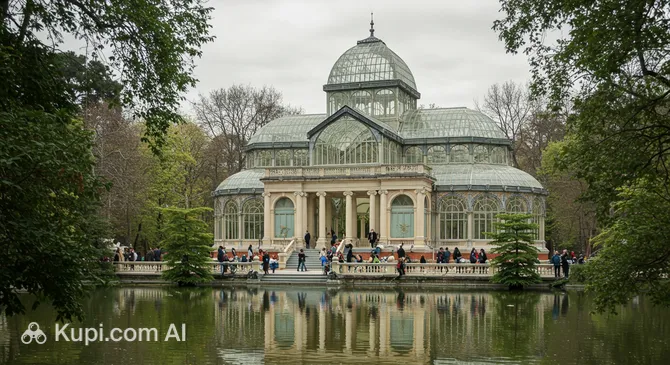
Crystal Palace. Illustration.
Source: Kupi.com AI

Traveler photos:

Erected in 1887 based on the design by architect Ricardo Velázquez Bosco, the palace is one of the best examples of 19th-century "iron architecture" in the country. It was originally built as a greenhouse for an exhibition of exotic plants brought from the Philippine Islands. The famous Crystal Palace in London's Hyde Park served as a model. Thanks to its design, the building is filled with light, creating a magical atmosphere inside.

Today, the Crystal Palace has moved beyond its original function and has become one of the exhibition venues for the Reina Sofía Museum. It regularly hosts contemporary art exhibitions and impressive installations that interact with the pavilion's unique space. A visit to the palace is an opportunity not only to touch the history of architecture but also to experience contemporary art in a truly extraordinary setting.

Contacts

Since the Crystal Palace serves as an exhibition venue for the Reina Sofía Museum, it is recommended to check the museum's official resources for all up-to-date information on current exhibitions, opening hours, and visiting conditions. Below are the main contact details.

How to contactContact
AddressP.º de Cuba, 4, Retiro, 28009 Madrid, Spain
Phone number+34 915 74 56 17
Websitewww.museoreinasofia.es

What to Do

A visit to the Crystal Palace is primarily an opportunity to enjoy its unique atmosphere. Walking inside, you will find yourself in a space flooded with natural light, where the transparent walls and ceilings create a sense of incredible lightness. Since the palace is an exhibition venue for the Reina Sofía Museum, it often hosts temporary exhibitions of contemporary art, conceptual installations, and performances. This allows you to do more than just view the building; you can discover works by famous artists in an unusual setting and take beautiful photographs.

The surroundings of the palace are equally impressive. Be sure to admire how the graceful structure is reflected in the still waters of the pond located right in front of the building—this is a favorite spot for photos. While walking along the cozy paths of Retiro Park, you might encounter peacocks roaming freely through the area. Inside the pavilion itself, you can sometimes catch special light installations, such as a "rainbow room," which transform the space with colorful reflections on the glass panels.

Getting There

Finding the Crystal Palace is quite easy—it is located in the central part of the famous Retiro Park, one of the most beautiful and largest in Madrid. The journey there is a pleasant stroll in itself, as the pavilion is surrounded by picturesque alleys, green lawns, and ponds. Entrance to Retiro Park itself is free, making a visit even more accessible.

The most convenient way to reach the park is by public transport. Several metro stations are located closest to the palace. You can take the metro to Retiro (Line 2, red), Ibiza (Line 9, purple), or Atocha, which is now called Estación del Arte (Line 1, blue). From the Retiro station, a walk through the park to the palace will take about 10 minutes.

In addition to the metro, Retiro Park is easily accessible by one of the many city buses with routes passing nearby. Another comfortable option is to take a taxi, which can drop you off right at one of the park entrances. For those who enjoy active recreation, a bicycle ride is an excellent choice—Madrid has a well-developed bike-sharing system, and there are several stations near the park.

Nearest city: Madrid

History & Facts

The history of the Crystal Palace is inextricably linked to the era of the great industrial and cultural exhibitions of the 19th century. It was built in record time—just five months—in 1887. The project was designed by the prominent Spanish architect Ricardo Velázquez Bosco, who drew inspiration from the famous Crystal Palace in London's Hyde Park. However, unlike its British prototype, the Madrid pavilion was originally created not for industrial achievements but as a giant greenhouse for an exhibition of exotic plants from the Philippine Islands, which were a colony of Spain at the time.

The architectural design of the palace was a true breakthrough for its time. The building is an elegant framework of iron and cast-iron columns, entirely covered with glass panels. The structure is crowned by a massive dome over 22 meters high, giving the entire building a resemblance to a majestic cathedral. This innovative use of materials created an incredibly bright and spacious interior, ideal for tropical flora. The grace of its lines and its harmonious blend with the surrounding landscape of Retiro Park make it one of the finest examples of "iron architecture" in Madrid.

After the exhibition ended, the pavilion was not dismantled as originally planned. It became a venue for various events, and in 1936, it even served as the site for the election of the president of the Second Spanish Republic, as no other hall could accommodate all the deputies. After a restoration in 1975, the palace found a new life and today serves as a branch of the Reina Sofía Museum. Now, its light-filled halls host contemporary art exhibitions and large-scale installations that engage in a dialogue with the unique architecture of this historic building.

Time Needed

When planning a visit to the Crystal Palace, it is worth considering that the duration of your visit depends directly on your interests. If your goal is to quickly see this magnificent building, admire its architecture, and take a few impressive photos against the backdrop of the glass walls and the pond, then 30 to 60 minutes will be quite sufficient. This is enough time to appreciate the lightness and elegance of the structure and feel the unique atmosphere of the place.

However, for a more complete and deeper impression, it is recommended to set aside more time. Since the pavilion is an exhibition venue, it often hosts interesting contemporary art installations and exhibitions, which may require additional time for thoughtful exploration. Furthermore, the Crystal Palace is a gem of Retiro Park, and a visit here perfectly complements a leisurely stroll along the park's picturesque paths. If you decide to combine your tour of the palace with a walk, plan to spend 1.5–2 hours or even more.

Working Hours

The Crystal Palace is open to visitors year-round, but its opening hours vary by season. During the summer months, the pavilion is typically open daily from 10:00 AM to 10:00 PM. In winter, its doors close significantly earlier—at 6:00 PM. Entrance to the pavilion is most often free, making a visit even more enjoyable.

It is important to remember that the Crystal Palace is an exhibition space, and its schedule may change during the preparation of new displays. Therefore, to ensure your visit goes smoothly, it is highly recommended to check the current schedule on the official website of the Reina Sofía Museum before your trip. Usually, advance booking is not required, but checking the information is always a good idea.

Nearby

A visit to the Crystal Palace is just one part of an exciting journey through Madrid. Since the pavilion is located in the famous Retiro Park, exploring its surroundings will provide a wealth of new experiences. A stroll through the park and its vicinity will allow you to discover other iconic landmarks of the capital of Spain, many of which are within walking distance.

Exploring the nearby attractions will enrich your trip, providing a more complete picture of the city's cultural and historical heritage. Just a few minutes' walk away are world-famous museums, majestic monuments, and picturesque gardens, each of which deserves individual attention.

NameDistance
Casa de Campo0.8 km
Prado National Museum0.9 km
Cibeles Fountain1.1 km
Thyssen-Bornemisza National Museum1.1 km
Museo Reina Sofía1.2 km
National Archaeological Museum1.2 km
Metropolis Building1.4 km

Have you reached the end of the page?

So the route has been studied inside and out