In the heart of Madrid, the capital of Spain, lies one of the city's most surprising treasures—the Temple of Debod. This is not a replica or a stylistic imitation, but an authentic ancient Egyptian temple dating back over two thousand years. Its presence in a bustling European metropolis is the result of the Egyptian government's gratitude for Spain's help in saving the Nubian temples from flooding during the construction of the Aswan High Dam in the 20th century. The temple was carefully dismantled, transported, and reassembled in Madrid's Parque del Oeste (Western Park), where it opened to the public in 1972.
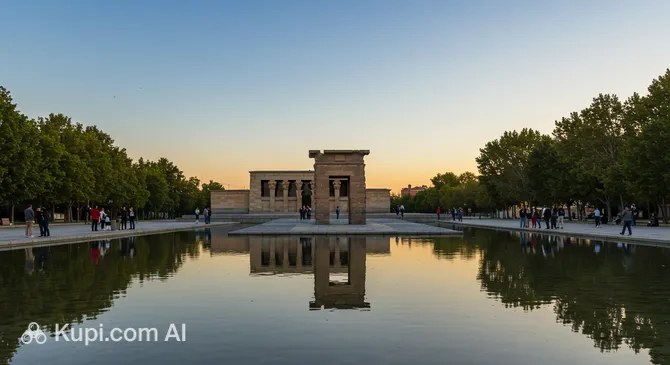
The Temple of Debod is a rare example of ancient Egyptian architecture outside of Egypt, making it especially valuable. The structure contrasts sharply with the surrounding cityscape, transporting visitors to another era and culture. The complex consists of several stone gateways and a main building, situated in the middle of a shallow pool symbolizing the waters of the Nile where it once stood. This water surface creates a particularly picturesque view at sunset when the lights come on and the temple is reflected in the water.
Traveler photos:
Originally, the temple was dedicated to the Egyptian gods Amun and Isis. Inside, you can see original reliefs and hieroglyphs on the walls, as well as visit a small exhibition with models and photographs telling the story of this monument and its grand "move." Despite its age, the temple is remarkably well-preserved, and a special microclimate is maintained inside to protect its condition. Visiting the Temple of Debod is a unique opportunity to touch the history of Ancient Egypt without leaving the borders of modern Europe.