Support

Synagogue of Santa María la Blanca

About

In the heart of the old Jewish quarter of Toledo lies one of Spain's most unusual attractions—the Santa María la Blanca Synagogue. This outstanding architectural monument is a testament to the city's rich multicultural past, where Christian, Jewish, and Islamic traditions coexisted peacefully for centuries.
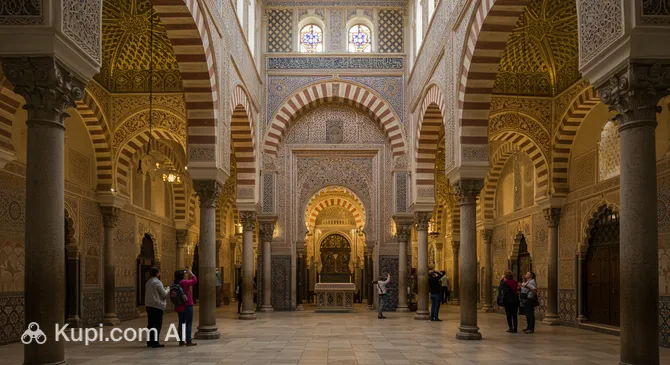
Synagogue of Santa María la Blanca. Illustration.
Source: Kupi.com AI

Traveler photos:

The building was constructed in 1180 and is a magnificent example of the Mudéjar style. Its interior captures the imagination: endless rows of snow-white horseshoe arches resting on slender octagonal columns create a sense of light and space, reminiscent of a forest of palm trees. The interior decoration, though lacking opulent decor, impresses with its harmony and elegance of lines, combining elements of various cultures.

Originally built as the city's main synagogue, it was converted into a Christian church in the 15th century, explaining its double name—"Saint Mary the White." Today, Santa María la Blanca is not a functioning church but is open to visitors as a unique historical and architectural museum, allowing you to connect with Toledo's unique history and enjoy its matchless atmosphere.

Contacts

If you are planning to visit the Santa María la Blanca Synagogue, we recommend checking the opening hours and ticket prices in advance. The most up-to-date information can be obtained using the official contact details of the attraction.

How to contactContact
AddressC. de los Reyes Católicos, 4, 45002 Toledo, Spain
Phone number+34 925 22 72 57
Websitetoledomonumental.com

What to Do

Visiting the Santa María la Blanca synagogue is a unique opportunity to immerse yourself in the history of Toledo, where cultures and religions have been closely intertwined for centuries. The main activity for visitors is a careful study of the building's unique architecture, which is a prime example of the Mudéjar style. Here you can spend hours looking at the details, taking photos, and feeling the atmosphere of tranquility and centuries-old history.

Inside the synagogue, your attention will be drawn to the snow-white "forest" of octagonal columns supporting elegant horseshoe arches. Be sure to look up to appreciate the complex wooden coffered ceilings. Visitors can examine the intricate carving on the column capitals in detail, each with its own unique pattern. Also of interest are the later Christian elements added after the synagogue's conversion into a church: Plateresque-style altars and altarpieces created by the Berruguete school.

For a deeper understanding of the history and symbolism of this place, guided tours are offered. During such a tour, you will learn about the life of the Jewish community in medieval Toledo, the architectural features of the building, and its subsequent transformation. A visit to the synagogue is easily combined with a walk through the Jewish quarter, where other iconic attractions are located nearby, allowing you to form a complete picture of the city's cultural heritage.

Getting There

The Santa María la Blanca synagogue is located in the heart of the historic Jewish quarter of Toledo, making it easily accessible for visitors. If you are traveling from Madrid, the most convenient way to reach Toledo is by high-speed train (AVE or Avant) or intercity bus. Upon arrival at the Toledo railway station or bus station, you can take a taxi or use a city bus to get to the historic center.

Once in the old town, you can reach the synagogue on foot. From the main square, Plaza de Zocodover, the walk takes approximately 10-15 minutes. Follow the signs toward the Jewish quarter (Judería), and you will easily find this unique building. Additionally, Hop-On Hop-Off tourist buses operate in Toledo, with routes passing near major attractions, including the synagogue, which can be a convenient alternative for sightseeing.

Nearest city: Toledo

History & Facts

The Santa María la Blanca synagogue is not just an ancient building, but a true symbol of the cultural diversity of medieval Toledo. It was erected in 1180, and most remarkably, it was built by Arab craftsmen for the Jewish community. This collaboration of talents gave the building its unique Mudéjar appearance, where elegant Islamic motifs harmoniously fit into the space of a Jewish temple, creating an atmosphere of lightness and light.

The building's history is full of dramatic events. In 1250, a major fire caused serious damage. However, thanks to the patronage of King Alfonso X of Castile, known as "the Wise," the synagogue was restored by 1260. After this reconstruction, carried out under the leadership of an influential community member, Joseph Ben Shoshan, it gained the status of the Main Synagogue of Toledo, highlighting its central role in the city's life.

The turning point came at the beginning of the 15th century. Following anti-Jewish riots across Spain, the synagogue was confiscated in 1411 and converted into a Christian church. It was then that it received its current name—Santa María la Blanca (Saint Mary the White)—and was handed over to the Order of Calatrava. Later, chapels were added to the building, and the famous sculptor Alonso Berruguete created an altar for it, traces of which can still be seen today.

Today, Santa María la Blanca is not an active place of worship but functions as a museum. It is one of the most important monuments vividly demonstrating the complex and rich history of Toledo, where Christian, Jewish, and Muslim cultures have intertwined for centuries. Visiting this site is an opportunity to experience the unique cultural heritage of the entire country.

Time Needed

To explore the Santa María la Blanca synagogue in Toledo, most visitors will need 30 to 60 minutes. This is quite enough time to immerse yourself in the unique atmosphere of the place, appreciate its unusual Mudéjar architecture, and take memorable photos. In half an hour, you will have time to walk through the main hall, admire the famous white columns and arches resembling a palm forest, and read the information boards telling the building's history.

If you have a deep interest in history or architecture, or want to leisurely study every detail of the interior, it is worth planning about an hour for the visit. This will allow you to more thoughtfully examine the carved capitals and unique ornaments, and imagine how this place functioned first as a synagogue and then as a church. Despite its historical significance, the synagogue is a relatively small site, so its visit can easily fit into even the busiest itinerary of Toledo attractions.

Working Hours

The Santa María la Blanca Synagogue in Toledo is usually open to visitors daily throughout the year. However, exact opening hours may vary depending on the season and holidays. For example, the schedule may be extended in summer and, conversely, shortened in winter.

To ensure your visit goes smoothly, it is highly recommended to check current information regarding opening hours and ticket prices on the official website of the attraction or at tourist centers in Toledo immediately before your trip. Generally, advance booking is not required for a visit, but during the peak tourist season, it is better to clarify this in advance to avoid long queues.

10:00 – 18:45

Nearby

A visit to the Santa María la Blanca Synagogue is a wonderful opportunity to touch the rich history of Toledo. However, to get a full picture of this amazing city, it is worth going beyond a single attraction and exploring its surroundings. The Jewish quarter, where the synagogue is located, is a living museum in itself, with its labyrinth of narrow streets and ancient buildings that hold centuries-old secrets.

A walk through nearby sites will allow you to dive deeper into the cultural heritage of the "city of three cultures." Many iconic monuments of Spain are located here within walking distance, making the exploration of the area particularly convenient and exciting. Below is a list of interesting sites located very close by.

NameDistance
Monastery of San Juan de los Reyes0.1 km
Synagogue of El Tránsito0.2 km
Church of Santo Tomé0.2 km
El Greco Museum0.2 km
Medina Mudéjar Toledo0.2 km
Puerta del Cambrón0.3 km
La Mafia Sits at the Table0.3 km

Have you reached the end of the page?

So the route has been studied inside and out