Support

Alcántara Bridge

About

The Alcantara Bridge is one of the most recognizable symbols of Toledo and an outstanding architectural monument in Spain. This ancient bridge spans the Tagus River at the foot of the majestic San Servando Castle and has served as one of the main entrances to the historic city center for centuries. Its very name, "Alcantara," comes from an Arabic word that translates simply as "the bridge," emphasizing its fundamental importance to the city.
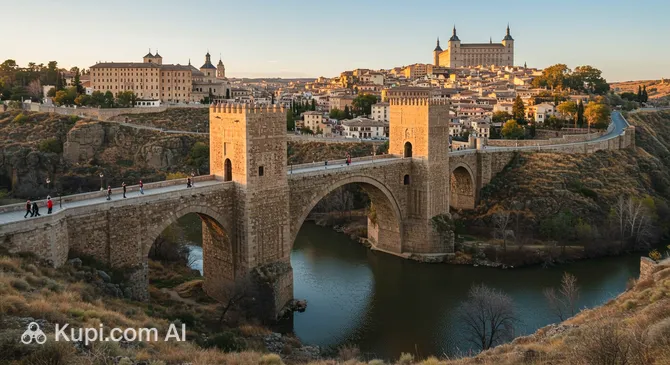
Alcántara Bridge. Illustration.
Source: Kupi.com AI

Traveler photos:

Built back in the Roman era, the Alcantara Bridge was repeatedly rebuilt and reinforced during the reigns of the Visigoths and Moors, as well as in the Middle Ages. Its powerful stone structure with characteristic semi-circular arches is a striking example of Roman engineering genius that has survived to this day. The entrances to the bridge are decorated with gates and a tower built in different eras, giving it an even more monumental appearance.

Today, the Alcantara Bridge is not just an important transport artery, but also a cultural heritage site of national significance. A walk across it allows you to feel the breath of history and enjoy stunning views of the river and the old town. It is a place where the past and present of Toledo merge, creating an unforgettable atmosphere for every traveler.

Contacts

Alcantara Bridge is a public historical monument, so it does not have specific contact details for tourists, such as a phone number or an official website. Finding it is very easy: the bridge is located at the foot of the hill near the Alcázar fortress, at Calle Gerardo Lobo, s/n. You can reach it on foot from anywhere in the historic center of Toledo by heading towards the Tagus River.

How to contactContact
Address45006 Toledo, Spain

What to Do

A walk across the Alcantara Bridge is an opportunity to touch history and enjoy some of the most picturesque views of Toledo. As you cross the Tagus River via this ancient structure, you can take magnificent panoramic photos of the old town, its fortress walls, and the surrounding landscape. The bridge is especially beautiful at sunrise and sunset, when the soft light highlights its ancient stonework and creates a magical atmosphere.

During your walk, pay attention to the architectural details. The bridge is decorated with two fortified gate-towers on opposite sides. On one of them, you can see the coat of arms of the Catholic Monarchs, and on the other, a statue of Saint Ildefonso, the city's patron saint. These elements are not just decoration, but witnesses to the bridge's centuries-long history, having survived numerous reconstructions and sieges.

Furthermore, the Alcantara Bridge is an ideal starting point for walking tours of the historic center of Toledo. Just past the bridge, the ascent to the heart of the city begins. Iconic attractions such as the Puerta del Sol and the Church of Santiago del Arrabal are located in the immediate vicinity. This makes the bridge not just a crossing, but an essential part of the tourist route through one of Spain's most impressive cities.

Getting There

Getting to the Alcantara Bridge is quite simple, especially if you are traveling from Madrid. The most convenient way to reach Toledo is by high-speed train or bus. The journey from the Spanish capital takes only 30–40 minutes, making Toledo an ideal destination for a day trip. Trains and buses arrive at stations from where you can easily continue your way to the historic city center.

The Alcantara Bridge is very conveniently located for travelers arriving by train. It is just a 10–15 minute walk from the Toledo railway station. Simply follow the signs toward the old town, and you will quickly find yourself at this ancient crossing. Many travelers begin their walk through the historic part of Toledo right here, as the bridge leads directly to the main city gates, offering a scenic entrance into the labyrinth of ancient streets.

Nearest city: Toledo

History & Facts

The Alcantara Bridge is not just a picturesque structure, but a true chronicle of Toledo's history captured in stone. Its name comes from the Arabic word "al-qanṭarah," which means "the bridge." The history of the crossing at this site began back in the days of the Roman Empire, when around 104 AD, the first stone bridge was built here by order of Emperor Trajan. It served as the main entrance to the ancient city of Toletum and was of strategic importance.

After the fall of the Roman Empire, the bridge underwent many changes. In 886, during the Moorish era, it was almost completely rebuilt and for a long time served as the only way into the city for pilgrims, merchants, and armies. It is this Moorish construction that forms the basis of the bridge we see today. In 1257, a massive flood destroyed the structure, but it was soon restored by decree of King Alfonso X the Wise, highlighting the bridge's importance to the Christian kingdom.

Over the centuries, the Alcantara Bridge has been restored many times and supplemented with new architectural elements. On the entrance from the city side, it is protected by a Mudejar-style tower, while at the opposite end stands a Baroque triumphal arch built in the 18th century. In 1921, due to its rich history and architectural value, the bridge was officially recognized as a national monument of Spain. Today, it remains one of the most recognizable symbols of Toledo, a silent witness to the passing of eras and cultures.

Time Needed

Exploring the Alcantara Bridge usually doesn't take much time, making it a convenient stop on any tourist route through Toledo. For most visitors, 30–45 minutes is sufficient. This time is enough to leisurely walk across the bridge, enjoy the views of the Tagus River and the city panorama, and take some impressive photographs.

If you want to study the surroundings in more detail and soak up the atmosphere of this historic site, you should plan for 1 to 1.5 hours. During this time, you can not only cross the bridge but also carefully examine its architectural details, including the ancient gates and defensive towers on both sides. This will also give you the chance to find the best angles for photography and perhaps rest a bit before continuing to explore other treasures of Spain.

Working Hours

The Alcantara Bridge in Toledo is not just an ancient monument, but also a public space open to everyone. Since the bridge is part of the city's infrastructure, it is accessible 24 hours a day, year-round. You can freely walk across it at any time of day or night to enjoy the magnificent views of the Tagus River and the ancient city walls.

No tickets or prior reservations are required to visit the Alcantara Bridge. Entrance is completely free. Particularly picturesque photos can be taken at sunrise or after sunset, when the lighting is turned on, creating a truly magical atmosphere.

Open 24 hours

Nearby

Visiting such an iconic landmark as the Alcantara Bridge is just the starting point for exploring the city. To truly experience the atmosphere of Toledo, it is worth exploring its surroundings. A stroll through the nearby streets can reveal hidden treasures, cozy local spots, and other interesting sites that will enrich your impressions and provide a more complete picture of the rich history and culture of this unique city.

The area around the Alcantara Bridge is full of historical and cultural sites located within walking distance. From museums with unique collections to the famous Alcázar, everything is situated nearby, allowing you to create a rich and educational itinerary for the whole day.

NameDistance
Museo Cromática0.2 km
Museum of Santa Cruz0.3 km
Army Museum0.3 km
Alcázar of Toledo0.4 km
Barrio Cocktail Restaurant0.4 km
El Peñón Restaurant0.5 km
Sala Pícaro0.5 km

Have you reached the end of the page?

So the route has been studied inside and out