Support

Puerta de Toledo

About

Puerta de Toledo is one of the most significant architectural landmarks in Madrid, the capital of Spain. This majestic monument is a triumphal arch built in the 19th century. The gate got its name because, historically, the road connecting the capital with the ancient city of Toledo began here. Today, it is one of the last major gates built within Madrid's old city walls.
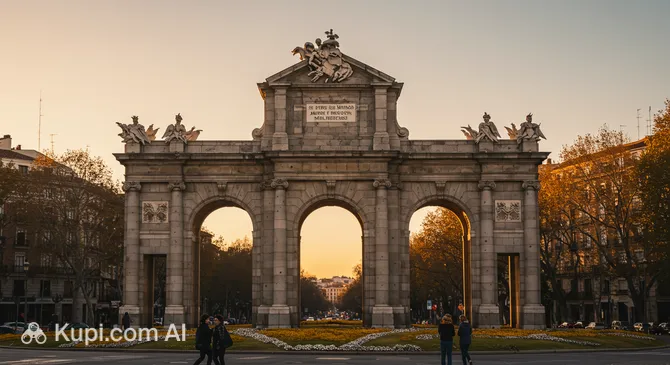
Puerta de Toledo. Illustration.
Source: Kupi.com AI

Traveler photos:

The design of the gate is executed in the Neoclassical style and consists of three sections: a central semicircular arch and two lateral rectangular arches. The structure is built from durable granite blocks and decorated with elegant semi-columns of the Ionic order, giving it a strict and classical look. The grandeur of the building emphasizes its monumental character, making the gate an important part of the urban landscape.

The upper part of the gate is crowned by an impressive sculptural group created by famous Spanish masters José Ginés, Ramón Barba, and Valeriano Salvatierra. In the center of the composition, you can see the coat of arms of Madrid supported by two child figures, while on the sides, there are sculptures depicting military trophies. These details not only decorate the monument but also carry historical meaning, recalling important events in the country's history.

Contacts

Puerta de Toledo is an open architectural monument, accessible for visiting 24/7 and requiring no tickets. The monument does not have its own office or telephone number. For any questions regarding tourist information in Madrid, you can contact the city's official tourist centers. You can reach the gate by metro to the Puerta de Toledo station or by city buses.

How to contactContact
AddressGta. de la Prta de Toledo, s/n, Centro, 28005 Madrid, Spain
Phone number+34 915 29 82 10
Websitewww.esmadrid.com

What to Do

A visit to Puerta de Toledo is primarily an opportunity to examine in detail one of the striking examples of Neoclassical architecture in Madrid. The main activity here is a leisurely viewing of the monument itself. Pay attention to the skillful sculptural composition that crowns the arch. On the north facade, you will see the coat of arms of Madrid supported by two child figures, and above the side openings, there are allegorical depictions of military trophies.

As you walk around the monument, look for the Latin inscription on the frieze dedicated to King Ferdinand VII. Since the gate itself is located in the center of a busy traffic junction turned into a well-kept flower bed, it is not possible to walk through it. However, this location makes it a great subject for photography. This site is an important historical landmark worth including in your walking tour of the city to appreciate its grandeur and take some memorable photos against the backdrop of one of the symbols of Spain's capital.

Getting There

Located in the central part of Madrid, Puerta de Toledo is an easily accessible attraction for tourists. This makes it a convenient point to include in any walking or transport route through the capital of Spain. The easiest and fastest way to reach the monument is to use the city's well-developed public transport system.

The most convenient option is the metro. Right at the foot of the attraction is the station of the same name, Puerta de Toledo, which is served by Line 5 (the green line). After exiting the metro, you will immediately find yourself in front of the majestic arch, eliminating the need to search for it on a map for a long time.

Additionally, the gate can be reached by numerous city buses with routes passing through this area. If you prefer walking and are in the historic center, for example, in the lively La Latina district or near Puerta del Sol, you can reach Puerta de Toledo on foot. The walk will take some time but will allow you to get a better feel for the city's colorful streets. Thanks to its location on a large traffic circle, the monument is visible from afar, making navigation easy.

Nearest city: Madrid

History & Facts

The history of Puerta de Toledo dates back to the 17th century, when in 1625, King Philip IV ordered the construction of a new gate on the site of the old one, which had fallen into disrepair. However, the modern appearance of this monument is linked to the turbulent era of the early 19th century and subsequent changes in the history of Spain. This gate was the last of the major monumental gates built within the old city walls of Madrid.

During the reign of Joseph Bonaparte, from 1806 to 1808, ambitious plans were developed for a more grand triumphal arch. This project was intended to glorify the new constitution adopted at the time. However, the plans were not destined to come to fruition: after Joseph's departure and the accession of King Ferdinand VII, everything changed. The new government decided to create its own monument to symbolize the restoration of the monarchy and liberation from foreign influence.

The design of the new gate was entrusted to the talented architect Antonio López Aguado. Construction took place from 1813 to 1827 and was dedicated to King Ferdinand VII. This fact is immortalized in the Latin inscription on the frieze, which reads: "Dedicated to Ferdinand VII, the Desired, father of the nation, recoverer of the land and deliverer from usurpation. The monument is dedicated by the government of Madrid to loyalty, triumph, and joy. Year 1827." Thus, Puerta de Toledo became not just an architectural structure, but a true symbol of national pride.

Time Needed

Viewing Puerta de Toledo usually takes very little time. For most tourists, allocating about 15–30 minutes will be sufficient. This is because the monument is a free-standing architectural landmark located in the center of a square, and it is viewed exclusively from the outside. During this time, you'll have enough time to appreciate the overall scale of the structure and take a few souvenir photos.

If you are interested in architecture or photography, you might stay a bit longer to carefully examine the details of the sculptural compositions decorating the arch or to find the best angle for a shot while waiting for the right lighting. Since the gate is located in a busy area, a visit is often part of a longer walk through the historical part of Madrid, such as the nearby colorful La Latina neighborhood.

Working Hours

One of the main advantages of Puerta de Toledo is its total accessibility. As it is an open-air monument located on a city square in Madrid, it does not have standard operating hours like museums. The attraction is open for viewing 24 hours a day, year-round, allowing tourists to plan a visit at any time convenient for them. Accordingly, no tickets or advance reservations are required — access to the monument is completely free.

While you can approach Puerta de Toledo even at night, for the best viewing and photography, it is recommended to visit during daylight hours. Daylight allows you to fully appreciate all the architectural details and sculptural compositions that decorate this outstanding monument of Spain.

Open 24 hours

Nearby

Viewing Puerta de Toledo is just the starting point for exploring one of Madrid's most colorful districts. To truly feel the city's atmosphere, it's worth taking a stroll through its surroundings. Just a few steps from the monument, lively streets, historic squares, and authentic establishments await, helping you dive deeper into the culture of the capital of Spain.

Exploring nearby attractions will enrich your journey, allowing you to form a more complete picture of Madrid's many facets. Setting off on foot, you can discover hidden courtyards, cozy tapas bars, and iconic spots that shape the unique character of this city.

NameDistance
San Miguel Market1 km
Plaza Mayor1 km
Rosi La Loca1.2 km
Inclán Brutal Bar1.2 km
Royal Palace of Madrid1.3 km
Museo Reina Sofía1.4 km
Calle 365 Madrid1.4 km

Have you reached the end of the page?

So the route has been studied inside and out