Support

Puerta de Alcalá

About

Puerta de Alcalá (Alcalá Gate) is one of the most recognizable and significant monuments in Madrid, located in the heart of the capital of Spain on Plaza de la Independencia. This majestic gate is not just an architectural masterpiece but also an important historical symbol that once served as the main entrance to the city. Today, it is one of the key attractions, constantly drawing the attention of tourists and city residents alike.
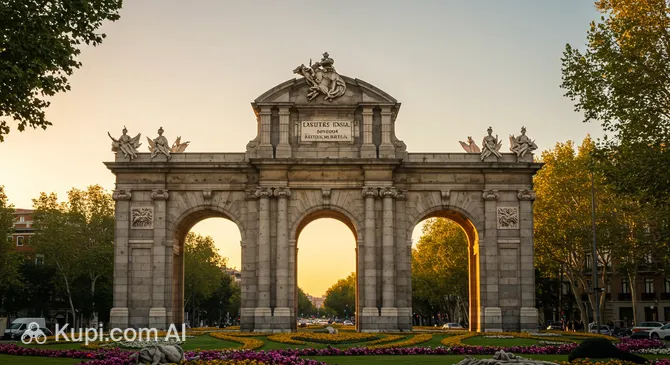
Puerta de Alcalá. Illustration.
Source: Kupi.com AI

Traveler photos:

The monument is a striking example of the architectural transition from Baroque to Neoclassicism. The gate is built of granite and limestone and features five openings: three large central arches and two rectangular side openings, giving it a strict yet elegant appearance. Originally, the gate stood on the road leading to the city of Alcalá de Henares, which is where it got its name.

Commissioned by King Charles III in the 18th century, the gate was part of his program to modernize and beautify Madrid. Nowadays, Puerta de Alcalá has lost its defensive function, turning into an iconic monument and a popular tourist site. It often becomes the center of city celebrations and a starting point for walks through the nearby famous Retiro Park.

Contacts

Since the Puerta de Alcalá is a public architectural monument located in an open square, it does not have specific contact details such as a phone number or email address. The monument is situated on Plaza de la Independencia and is open for viewing at any time of day. The most convenient way to reach the gate is by metro to the Retiro station (Line L2) or Banco de España (Line L2), as well as by one of the numerous city buses that stop nearby.

How to contactContact
AddressPl. de la Independencia, s/n, Retiro, 28001 Madrid, Spain
Websitewww.esmadrid.com

What to Do

A visit to Puerta de Alcalá is an opportunity to touch history and feel the atmosphere of majestic Madrid. It is a favorite spot for strolls and commemorative photos, and the monument looks especially impressive at different times of the day thanks to its sophisticated artistic lighting. Plaza de la Independencia, where the gate is located, is a lively hub in itself, from which you can enjoy panoramic views and feel the rhythm of the old city. Moreover, it is a wonderful starting point for further exploration of the capital: the entrance to the famous Retiro Park is nearby, as are many prestigious restaurants.

A special pleasure is to carefully examine the gate's rich decorative elements. At the top of the monument are sculptures symbolizing the four cardinal virtues: justice, wisdom, temperance, and fortitude. These details do not just decorate the structure but reflect the ideals of the Enlightenment era in which it was created. It is also worth paying attention to the reliefs, which tell of significant events in the history of Spain, such as the arrival of King Charles III in the capital. Studying these details allows for a deeper understanding of the cultural and historical significance of one of the city's main symbols.

Getting There

Getting to the Puerta de Alcalá is very easy, as it is located in the heart of Madrid, on Plaza de la Independencia. One of the most convenient methods is the metro. The nearest station is Retiro, served by Line L2. Also nearby is the Banco de España station, which is on the same L2 line. From either of these stations, it is only a few minutes' walk to the monument.

Besides the metro, you can reach Plaza de la Independencia on one of the many city buses — the nearest stop is named Plaza de la Independencia or Puerta de Alcalá. Thanks to its central location, the Alcalá Gate is easily accessible on foot from other iconic city spots, such as Puerta del Sol or Gran Vía. Such a walk will allow you to better experience the architecture and atmosphere of the capital of Spain.

If you plan to travel by car, keep in mind that traffic in central Madrid can be heavy, especially during peak hours. There are paid parking lots near the square, but finding a free space is not always easy. Therefore, for visiting Puerta de Alcalá, public transport or walking is often a more convenient and faster option.

Nearest city: Madrid

History & Facts

The history of the modern Puerta de Alcalá is inextricably linked with King Charles III, who in the 18th century launched a large-scale program to modernize Madrid. The monarch disliked the old 16th-century brick gate and ordered it to be replaced with a more grand structure worthy of the capital. The project was commissioned to the Italian architect Francesco Sabatini, and construction was completed in 1778. Interestingly, Puerta de Alcalá became the first triumphal arch built in Europe since the fall of the Roman Empire, predating such famous monuments as the Arc de Triomphe in Paris and the Brandenburg Gate in Berlin.

The architectural appearance of the gate was inspired by ancient Roman triumphal arches, emphasizing its symbolic role as the main entrance to the capital of Spain. A unique feature of the Puerta de Alcalá is that its two facades — the outer one, facing those entering the city, and the inner one — are designed differently. The outer side is more ornate and lavish to impress guests of the capital, while the inner side looks more understated. Above the central arch on both sides, there is a Latin inscription: "Rege Carolo III. Anno MDCCLXXVIII," which translates to "Under King Charles III. Year 1778."

Another remarkable fact is that the gate was originally part of the city wall that surrounded Madrid. However, the wall itself stood for nearly a hundred years longer than the gate and was only dismantled in the 19th century when Madrid began to expand rapidly. The monument's rich sculptural decoration, including allegorical figures and military trophies, was created by the prominent masters of the time — Francisco Gutiérrez Arribas and Roberto Michel — giving the gate special artistic value.

Time Needed

When planning a visit to Puerta de Alcalá, keep in mind that the duration of the visit can vary greatly. For a quick look at the monument, a walk around Plaza de la Independencia, and taking a few commemorative photos, 20–40 minutes is usually enough. This time is sufficient to appreciate the overall scale and beauty of the gate, which is one of the main symbols of Madrid.

If you want to immerse yourself more deeply in the atmosphere of this place, it is worth allocating more time. For example, you can leisurely examine all the architectural details, including the sculptures and reliefs that tell the history of Spain. Additionally, the gate is located right at the entrance to the famous Retiro Park, so many tourists combine viewing the landmark with a long walk through the park, which can take another couple of hours.

Thus, a visit to Puerta de Alcalá is easy to fit into any schedule. It can be a short stop during a city sightseeing tour or a starting point for a multi-hour exploration. If you plan to finish your walk with lunch or dinner at one of the nearby restaurants, you can safely set aside half a day for all activities.

Working Hours

A great advantage of Puerta de Alcalá is its complete accessibility. Since it is an open monument located in a square, it is open for viewing 24 hours a day, year-round. You do not need to buy tickets or book a visit in advance — access to the gate is absolutely free of charge for everyone.

It should be noted that entry inside the structure itself is not possible, as it is primarily an architectural monument for external viewing. You can approach it at any convenient time to take photos and examine the details. Many travelers recommend visiting the gate twice: during the day to appreciate its architectural grandeur, and in the evening when the spectacular lighting is turned on, creating a special, magical atmosphere.

Open 24 hours

Nearby

The location of Puerta de Alcalá on Plaza de la Independencia makes this monument an ideal starting point for exploring one of the most attraction-rich parts of Madrid. A walk through the surrounding area will allow you not only to see the famous gate but also to immerse yourself in the cultural and historical atmosphere of the capital of Spain. Famous boulevards, parks, and museum quarters begin just a few steps from here.

Exploring the nearby sites will enrich your journey and help you form a more complete impression of the city. Within walking distance of the gate are world-famous museums, picturesque parks, and architectural masterpieces that together create the unique face of Madrid. Below is a list of some iconic places located very nearby.

NameDistance
Cibeles Fountain0.4 km
National Archaeological Museum0.4 km
Metropolis Building0.7 km
Prado National Museum0.7 km
Thyssen-Bornemisza National Museum0.7 km
Bel Mondo0.8 km
Crystal Palace0.9 km

Have you reached the end of the page?

So the route has been studied inside and out