Support

Comoros

Cities in the country

About

The Comoros is a charming archipelago in the Indian Ocean, nestled between the east coast of Africa and Madagascar. These so-called "Islands of the Moon" attract travelers with their untouched nature, a unique cultural blend of African, Arabic, and French traditions, and an atmosphere of true tranquility. Guests are greeted by impressive volcanic landscapes, lush tropical vegetation, and a pleasant warm climate throughout the year.

The capital of the Comoros, Moroni, is located on the largest island of the archipelago – Grande Comore (Ngazidja). This city is not only the administrative but also the main economic and cultural center of the country. Moroni has preserved the charm of ancient Arab quarters with their narrow winding streets and colorful markets, where you can fully experience the authentic spirit of the islands and purchase local souvenirs.
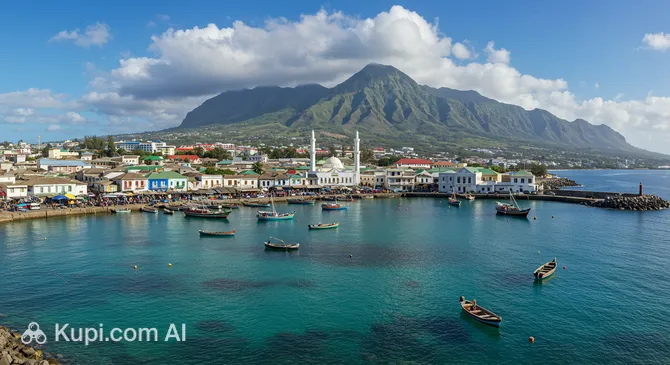
Illustration.
Source: Kupi.com AI

The Comoros is a real paradise for connoisseurs of ecotourism and quiet, secluded relaxation. Here you can explore the slopes of the active Karthala volcano, enjoy relaxation on uncrowded beaches with white sand and crystal clear water, and go diving or snorkeling among rich coral reefs. In addition to the capital, other cities are also of interest to visit, such as Mutsamudu on the island of Anjouan, known for its historical center. The Comoros offers travelers a rare opportunity to discover a truly unexplored and authentic destination, far from noisy tourist crowds.


Currency

The national currency of the Comoros is the Comorian franc (KMF). The exchange rate of the Comorian franc is pegged to the Euro, which provides a certain level of stability. Banknotes of various denominations are in circulation, such as 500, 1,000, 2,000, 5,000, and 10,000 francs, which are often decorated with images of local flora, fauna, cultural symbols, or famous figures, reflecting the rich heritage of the islands. Coins are also used for small transactions.

Exchanging foreign currency, preferably Euros or US Dollars, for Comorian francs is recommended at banks or official exchange offices in the capital, Moroni, or other large settlements. Try to avoid exchanging money with street money changers due to the risk of fraud and unfavorable rates. Keep in mind that the use of credit cards in the Comoros is extremely limited and is possible mainly in large hotels and with some airlines. Therefore, it is strongly recommended to carry enough cash to cover daily expenses, especially if you plan to travel outside the capital.

Visa Requirements

To visit the Comoros, most foreign citizens, including travelers from the EU, the USA, and the CIS, generally require a visa. A tourist visa can usually be obtained upon arrival at the country's airport or seaport. To do this, you must have a valid foreign passport with an expiration date exceeding the date of your intended departure from the country. Return tickets, proof of hotel booking, and medical insurance may also be required.

Despite the relative ease of obtaining a visa on arrival, visa rules can change. Therefore, it is strongly recommended to check the latest information on visa requirements and necessary documents on the official websites of the embassies or consulates of the Comoros in your country of residence or at the nearest diplomatic mission before your trip.

We'll let you know if you need a visa

Enter your destination or
Your nationality
Destination

Timezones

When planning a trip to the Comoros, you won't have to worry about changing time zones within the country. A single time zone operates throughout the entire territory of the Comoros.

The official time zone of the Comoros is East Africa Time (EAT), which corresponds to UTC+3. This means that local time is three hours ahead of Coordinated Universal Time. Thus, the time in the capital, Moroni, and on other islands of the archipelago will be the same.

Getting There

The Comoros is an island nation in the Indian Ocean, so the main and most convenient way to get here is by air. The country's main gateway is the Prince Said Ibrahim International Airport (HAH), located near the capital, Moroni. It is this airport that receives most international flights. Direct flights to the Comoros are usually available from some African countries (e.g., Tanzania, Kenya, Ethiopia) and the Middle East (e.g., the UAE). There are also flight options with connections through major European aviation hubs, such as Paris, or through other international hubs.

Since the Comoros is an archipelago, there are no ways to get here by land. Regarding maritime transport, regular international passenger service is poorly developed and is not the primary way of arrival for most tourists. Sometimes cargo ships heading to Comorian ports can take passengers on board, but this is more of an exception. Cruise ships may include the Comoros in their Indian Ocean itineraries, offering the opportunity to visit the islands, but this is part of a tour package rather than regular transport. When planning a trip, especially during the peak tourist season, it is strongly recommended to book flight tickets in advance to get the best prices and guarantee availability.

AirportCityIATA
Prince Said Ibrahim International AirportMoroniHAH
OuaniOuaniAJN

The Comoros, a charming archipelago of volcanic origin, offers travelers both lively urban centers and secluded resort corners. The heart of the archipelago is its capital, Moroni, located on the largest island, Grande Comore (Ngazidja). This city serves as the main gateway to the country and attracts tourists with its colorful markets, an ancient Medina with narrow winding streets, and the famous Old Friday Mosque. Moroni is also an excellent starting point for exploring the island's natural beauties, including pristine beaches and the active Karthala volcano.

Illustration.
Source: Kupi.com AI

In addition to the capital, the Comoros boasts other interesting cities. Mutsamudu, the second-largest city and the main port of the island of Anjouan (Ndzouani), charms with its historical citadel and picturesque old town. Here you can immerse yourself in the local culture and enjoy breathtaking views of the harbor. On the island of Mohéli (Mwali), the smallest of the main islands, is Fomboni, offering a quieter and more measured holiday. This city is the gateway to the Mohéli Marine Park, known for its sea turtle nesting sites and rich underwater world, making it a paradise for snorkeling and diving enthusiasts.

Another notable location is Domoni on the island of Anjouan. This city has a rich historical past, having been a former capital and an important trading port. Its ancient architecture and quieter atmosphere create a pleasant contrast to the larger cities of the archipelago. Each of these destinations reveals a unique facet of the diverse character of the Comoros, inviting further exploration.

Top Attractions

The main natural feature of the archipelago and a magnet for active tourism enthusiasts is the Karthala volcano, located on the island of Grande Comore. It is one of the most active volcanoes in the world with one of the largest calderas. Climbing to its summit is a journey through changing climatic zones: from humid tropical forests with giant ferns to lunar volcanic landscapes at the top. Fantastic views open up from the edges of the crater, allowing you to feel the power and majesty of the nature of these islands.

For fans of the underwater world and wildlife, the Mohéli Marine Park is a true treasure. This is the country's first national park, created to preserve a unique marine ecosystem. Its turquoise waters are home to rare dugongs, dolphins, and whales, but the park's main pride is its population of green sea turtles, which come to the local beaches every year to lay eggs. This place is ideal for ecotourism and snorkeling, giving a sense of complete unity with untouched nature.

The mystical Lake Lac Salé (Salt Lake), located in the north of Grande Comore, is shrouded in legends. This body of water, which filled an ancient crater right at the edge of the ocean, strikes the imagination with the unusual color of its water and its picturesque surroundings. Local legends say that the lake is bottomless, and swimming in it is not customary out of respect for the spirits. Very close by, you can see the famous Dos du Dragon rocks ("Dragon's Back"), whose pointed peaks, resembling the spine of a mythical creature, rise picturesquely against the background of the sea horizon.

Best Time to Visit

Choosing the time for a trip to the Comoros depends on your preferences and plans. The climate on the islands is tropical maritime, with two main seasons. The high season generally lasts from May to October or November. During this time, the weather is drier and cooler, with air temperatures around +25-28°C, making it ideal for beach holidays, diving, snorkeling, and exploring the islands. The ocean is calm, and underwater visibility is excellent. The downsides may be higher accommodation prices and a larger number of tourists, although the Comoros is not yet experiencing excessive tourist crowds.

The low season, or rainy season, falls between December and April. During this time, it becomes hotter and more humid, with frequent but usually short-lived downpours, especially in the afternoon. Temperatures can reach +30°C and above. There is also a possibility of tropical cyclones, especially from January to March. The advantages of this period are fewer tourists, lower prices, and lush, bright green vegetation. However, some roads may be washed out, and boat trips are sometimes canceled due to the weather. It is worth noting that it is during this wet season that the islands are particularly picturesque.

When planning your trip, also consider local holidays such as Independence Day (July 6) and Muslim festivals, the dates of which change annually according to the lunar calendar. During these periods, you can witness interesting cultural events. Also, for nature lovers, certain months may be more favorable for observing sea turtles coming ashore to lay eggs (often from May to October, but it is better to check information before the trip). Although the climate on all islands of the archipelago is similar, small local differences are possible, so it is always useful to check the forecast for the specific island you plan to visit, whether it is Grande Comore with the capital Moroni, Anjouan with the city Mutsamudu, or Mohéli.

Traditions

The Comoros is a country with deep cultural traditions, where respect for elders and warm hospitality play a key role. When greeting locals, especially those of an older age, it is customary to show respect. A handshake is a common form of greeting, especially between men, often accompanied by warm words and questions about health and family. Eye contact during conversation is usually maintained and is considered a sign of sincerity. Comorians are famous for their hospitality; if you are invited into a home, it is a sign of great respect. Although gifts are not strictly mandatory, a small souvenir from your country or sweets for children will be warmly received. It is customary to offer guests food and drink, and it is considered polite to accept the treat.

When visiting the Comoros, it is important to remember clothing norms, especially in public places and when entering religious sites. It is recommended to choose modest clothing that covers shoulders and knees for both men and women. When visiting mosques, women may be required to cover their heads with a scarf. At the table, especially if food is served on a common dish, it is customary to eat with the right hand. One of the most important holidays is Eid al-Fitr, marking the end of the holy month of Ramadan, which is celebrated with prayers, festive feasts, and exchange of visits. To avoid offending locals, try to avoid public displays of affection, always ask permission before photographing anyone, and remember that the left hand is traditionally considered "unclean," so it is better to use the right hand for passing objects or food.

Entertainment

The Comoros is a true paradise for lovers of active recreation, especially water sports. The transparent waters of the Indian Ocean create ideal conditions for diving and snorkeling, opening up a magical world of coral reefs and rich marine fauna to travelers. Boat trips and fishing are also popular. For those who prefer land adventures, the volcanic landscapes of the islands offer fascinating hiking routes, including the possibility of climbing the active Karthala volcano.

Cultural entertainment in the Comoros is closely intertwined with local traditions. While there may not be large theaters or concert halls in the traditional sense, you can immerse yourself in the authentic atmosphere by attending local festivals or listening to traditional music. As for shopping, it is mainly concentrated in colorful markets where tourists can purchase unique handmade items, fragrant spices, the famous local vanilla, and essential oils, especially ylang-ylang, which is a signature of the islands. The main shopping points can be found in the capital, Moroni, as well as in other cities such as Mutsamudu.

Nightlife in the Comoros is characterized by calm and tranquility, offering relaxing evening leisure rather than noisy parties. This mostly involves dinners in cozy restaurants serving Creole cuisine and the freshest seafood, often with an ocean view. There are few loud night clubs here. For family holidays, the islands offer magnificent uncrowded beaches where children can play and swim safely, as well as the opportunity to get acquainted with unique flora and fauna while exploring the natural beauty of the Comoros.

Currency rates

Planning a trip? Wonderful! To make sure the financial side of your journey holds no surprises, it's worth remembering that exchange rates are constantly changing. That's why we strongly recommend keeping an eye on current rates both before departure and throughout your trip. To help with that, you can use the data provided below — we monitor exchange rates 24/7 and strive to provide the most up-to-date information.

Reached the bottom of the page?

Looks like you know this route inside out

We use cookies for your convenience.