San Marino

About

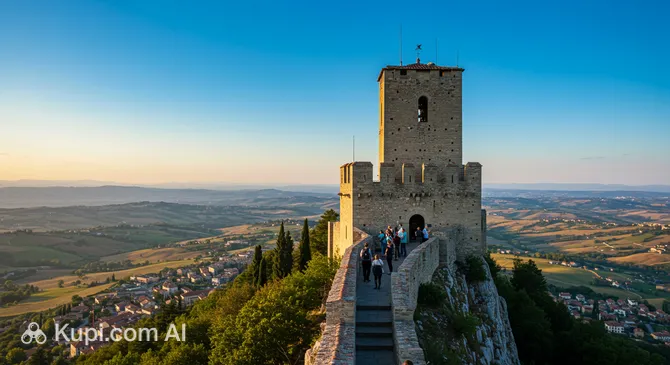
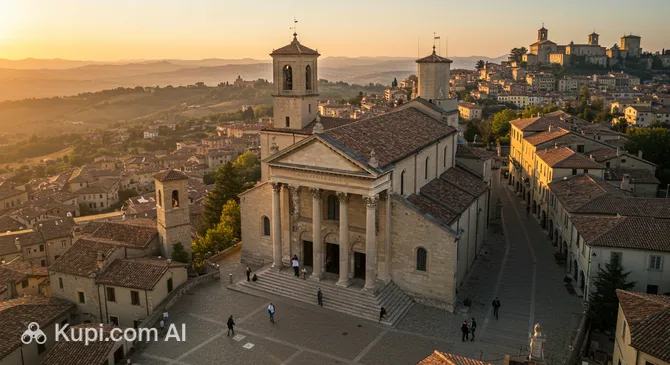
San Marino is not just a country, it's a real journey back in time! Situated on the slopes of Mount Titano and completely surrounded by Italian territory, this tiny republic takes pride in its centuries-old history, being the oldest sovereign state and the oldest republic in the world. Its compact size makes it easy to explore its charm, which is steeped in the spirit of the Middle Ages and independence.

The heart of the country is its eponymous capital – the city of San Marino. A stroll through its narrow cobbled streets, surrounded by ancient walls, will provide an unforgettable experience. The main symbols and must-visit sites are the three famous towers rising proudly on the peaks of Monte Titano, among which the Guaita Tower is particularly famous. From their observation decks, breathtaking panoramic views of the Apennine Mountains and the Adriatic coast unfold.
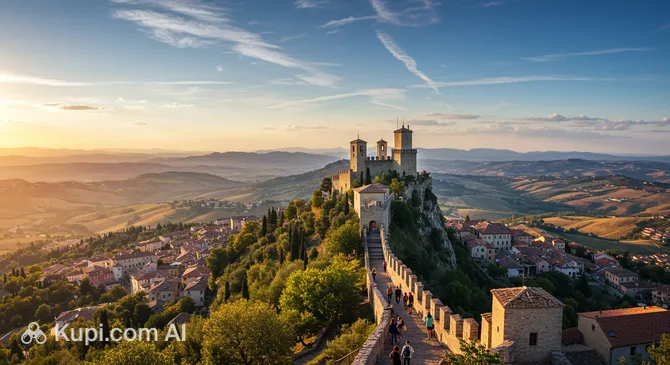
Illustration.
Source: Kupi.com AI

In addition to the capital, the picturesque town of Borgo Maggiore, located at the foot of the mountain and connected to the capital by a funicular, is well worth a visit. San Marino offers a unique atmosphere of tranquility, rich culture, interesting museums, and, of course, magnificent photo opportunities. It is the perfect place for those seeking unusual experiences and wanting to touch living history in one of Europe's most unique corners.

Currency

The official currency of San Marino is the Euro (EUR). Although the country is not a member of the European Union, it has a special agreement with Italy and the EU that allows it to use the Euro. Euro banknotes are identical to those used throughout the Eurozone. However, San Marino has the right to mint its own Euro coins with unique national designs on one side. These coins, often depicting historical symbols and landmarks of the republic, are legal tender throughout the Eurozone but are especially valued by collectors and can make a wonderful souvenir.

If you are arriving from a country outside the Eurozone, you can exchange your currency for Euros at banks or official exchange offices either in your home country or upon arrival in Italy or San Marino itself. It is recommended to use banks or licensed exchange offices to get the best rate and avoid fraud. Credit and debit cards (such as Visa, Mastercard) are widely accepted in most hotels, restaurants, shops, and tourist sites in San Marino. Nevertheless, it is always useful to carry a small amount of cash for minor expenses, market purchases, or at small establishments where card payment might be difficult.

Visa Requirements

When planning a trip to San Marino, it is important to remember its unique geographical location. Since the country has no international airports or seaports of its own, entry into its territory is via Italy. Consequently, visa requirements for visiting San Marino essentially coincide with the entry rules for Italy and the Schengen Area. Citizens of the European Union, the USA, Canada, Australia, and many other countries allowed visa-free entry into the Schengen Area for short stays (usually up to 90 days) do not require a separate visa to visit San Marino. However, if you require a Schengen visa to enter Italy, that same visa will be valid for visiting San Marino as well. Typically, this is a tourist Schengen visa (Type C).

Regardless of visa formalities, you will definitely need a valid passport to enter San Marino. It is also recommended to carry confirmation of return tickets, hotel bookings, medical insurance, and proof of sufficient financial means, as these are standard requirements for entering the Schengen Area. Since visa rules can change, we strongly advise checking current information on the official websites of Italian embassies or consulates in your country of residence before your trip, as they are the ones responsible for issuing Schengen visas covering entry to San Marino.

We'll let you know if you need a visa

Enter your destination or
Your nationality
Destination

Timezones

When planning a trip to San Marino, you won't have to worry about changing time zones within the country. The entire territory of San Marino is in a single time zone. The country uses Central European Time (CET), which is UTC+1. Like many European countries, San Marino observes Daylight Saving Time (CEST), shifting the clocks forward by one hour (UTC+2), typically from late March to late October.

Therefore, when planning your travel and activities in San Marino, you only need to refer to the single time active throughout the country. This simplifies logistics and allows you to enjoy your stay in this unique republic as comfortably as possible.

Getting There

Reaching San Marino, a picturesque enclave within Italy, can be done in several ways, though the primary route is via Italian transport hubs. The republic does not have its own international airport. Travelers usually fly into one of the nearest major Italian airports, such as Rimini Airport (Federico Fellini), which is just a few dozen kilometers away, or larger hubs in Bologna (Guglielmo Marconi), Ancona, or Florence. Regular bus services operate from these cities to San Marino; alternatively, you can use taxi services or rent a car for greater convenience. Direct flights to these Italian airports are available from many European countries, and convenient connections are usually offered for flights from more distant regions of the world.

The main, and essentially the only way to get directly into San Marino territory, is by land transport. After arriving in Italy by plane or if you are traveling through the country by train (the nearest major railway station is Rimini), the journey continues by road. The most popular option is the bus from Rimini to San Marino, which runs several times a day; the trip takes about an hour and offers beautiful views along the way. Naturally, you can also travel by private or rental car, which gives more freedom to explore the surroundings. Given San Marino's geographical position as a landlocked enclave, sea transport is not used to enter the country.

When planning a trip to San Marino, especially during the peak tourist season (summer months, Christmas, and other holidays), it is highly recommended to book in advance flight tickets to Italy and, if possible, bus tickets to San Marino. This will not only help find better fares but also ensure seat availability. It is also important to remember that since entry to San Marino is via Italian territory, travelers from countries outside the Schengen Area may require an appropriate visa to enter Italy.

San Marino, one of the world's oldest and smallest republics, offers travelers a unique immersion into medieval history surrounded by breathtaking landscapes. Despite its compact size, the country is rich with charming municipalities, each possessing its own unique charm and historical heritage. There are no traditional seaside resorts here, but every corner of the country is a kind of resort for the soul seeking peace, beauty, and cultural enrichment.

Illustration.
Source: Kupi.com AI

The main magnet for tourists is certainly the capital – the city of San Marino, majestically perched atop Mount Titano. Its famous three towers, narrow cobbled streets, and ancient walls transport visitors to another era. At the foot of the mountain lies Borgo Maggiore, a historically important trade center and a popular starting point for the ascent to the capital, offering magnificent views. Serravalle, the largest municipality, attracts fans of shopping and sporting events. It is also worth visiting picturesque municipalities such as Domagnano with its ancient fortifications and Fiorentino, which offers a peaceful atmosphere and beautiful natural landscapes. Each of these places opens its own unique page in the rich history and culture of San Marino.

Top Attractions

San Marino, one of the world's oldest republics, boasts many historical treasures that attract travelers from around the globe. Several key attractions stand out among them.

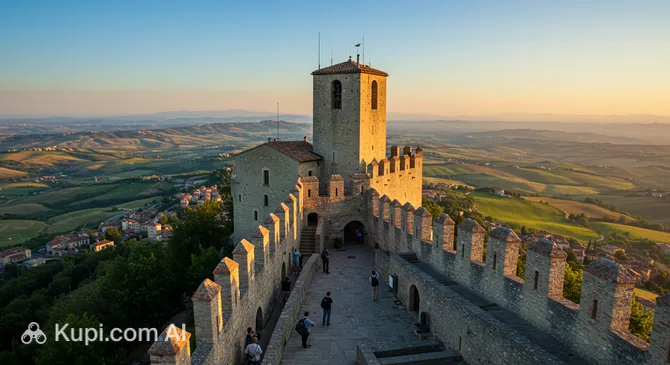
One of the most recognizable and symbolic structures is the Guaita Tower. This is the first and oldest of the three towers crowning the peak of Mount Titano. Breathtaking panoramic views of the surrounding landscapes open from its walls, and the tower itself allows you to touch the country's medieval history.

Illustration.
Source: Kupi.com AI

Traveller photos:

Not far from Guaita is the Second Tower, also known as Cesta or Fratta. Located on the highest point of Mount Titano, it serves as the home for the Museum of Ancient Arms, which presents an interesting collection of armor, bladed weapons, and firearms from various eras.

Illustration.
Source: Kupi.com AI

Traveller photos:

The spiritual center of the republic is rightfully considered the Basilica di San Marino. This magnificent neoclassical temple is dedicated to the founder and patron saint of San Marino. The saint's relics are kept inside the basilica, making it an important pilgrimage site and an object of interest for admirers of religious architecture and history.

Illustration.
Source: Kupi.com AI

Traveller photos:

The heart of public and political life in San Marino is Piazza della Libertà (Liberty Square). Standing here is the Palazzo Pubblico (Public Palace) – the active government building, built in an elegant Neo-Gothic style. On the square, you can admire the architecture, watch the changing of the guard ceremony, and simply enjoy the unique atmosphere of this ancient city-state.

Best Time to Visit

High season in San Marino usually falls between late spring and early autumn, roughly from May to September. During this time, the weather is warm and sunny, ideal for long walks through the cobbled streets of the capital, San Marino, and for visiting the famous towers with their panoramic views. All attractions are open, and life in the republic is in full swing. The main advantage of this period is the comfortable weather for outdoor activities and excursions. However, one should be prepared for a large influx of tourists and potentially higher prices for accommodation and services.

Low season, or the shoulder season, spans spring (March-April) and autumn (October-November). During these months, the weather can be more changeable, ranging from pleasant sunny days to cool and rainy ones. Winter (December-February) is the quietest time, when temperatures drop and occasional mists can occur, giving the ancient walls a special charm. The advantages of traveling in the low season include fewer tourists, a calmer atmosphere, and potentially better prices. The downside can be unstable weather and a possible reduction in the opening hours of some tourist sites. When planning a visit, it is worth noting that San Marino hosts interesting events, such as the famous "Medieval Days" at the end of July, which immerse guests in an atmosphere of knightly tournaments and historical reenactments, as well as the celebration of the Republic's Foundation Day on September 3rd.

Traditions

San Marino, the world's oldest republic, is proud of its traditions that date back through the centuries. Locals, the Sammarinese, are generally friendly and hospitable. When meeting, it is customary to greet with a handshake while maintaining eye contact; common greetings are "Buongiorno" (good day) and "Ciao" (hi/bye, more informal). If you are invited to a home, a small token of appreciation, such as a bottle of good wine or high-quality sweets, will be received with gratitude, although it is not a strict requirement. In general, the Sammarinese value politeness, restraint, and a respectful attitude toward their culture. Try not to be excessively noisy in public places, especially near churches, and always ask permission before taking photos of people.

When visiting the numerous religious sites in San Marino, such as ancient churches and basilicas, it is important to follow the dress code: shoulders and knees should be covered for both men and women. In everyday life, there are no strict requirements for clothing, but neatness and tidiness are always appreciated. At the table, European rules of etiquette are followed; it is considered good manners to try all the dishes offered and not to start eating before the hosts. To understand the spirit of the country more deeply, look to its main holidays. Republic Foundation Day (Festa di San Marino e della Fondazione della Repubblica), celebrated on September 3rd, is a vibrant event with historical reenactments, parades, and traditional crossbow competitions, demonstrating the Sammarinese pride in their centuries-old independence. Another unique and colorful tradition is the Investiture Ceremony of the Captains Regent (Cerimonia di Insediamento dei Capitani Reggenti), held twice a year on April 1st and October 1st, which highlights the ancient democratic foundations of this amazing state.

Entertainment

San Marino offers its guests a charming blend of historical discovery and relaxed modern entertainment. For lovers of active recreation, there are picturesque hiking trails through the hilly terrain, especially around Mount Titano, which offers breathtaking panoramic views. The cultural program is rich with visits to numerous attractions: ancient towers like the Guaita Tower and the Second Tower, old churches including the Basilica di San Marino, and historical squares such as Piazza della Libertà.

You can delve deeper into history and culture in a variety of museums, ranging from state collections to more unusual ones, such as the Museum of Medieval Criminology and Torture. Shopping in San Marino is attractive for the chance to purchase unique souvenirs, local ceramics, leather goods, philatelic and numismatic products, as well as to take advantage of duty-free shopping on certain items. Evening life is mainly concentrated in the capital, the city of San Marino, offering cozy restaurants and bars where you can enjoy traditional cuisine and local wines in a relaxed atmosphere.

For family vacations, San Marino offers an exciting journey into the past: exploring medieval castles and fortresses fires the imagination of both children and adults. Strolling through narrow cobbled streets and visiting small toy and candy shops will also bring joy to the whole family. Overall, entertainment in this microstate is oriented towards educational, cultural, and steady-paced relaxation, allowing you to enjoy the unique atmosphere of one of the world's oldest states.

Currency rates

Planning a trip? Wonderful! To make sure the financial side of your journey holds no surprises, it's worth remembering that exchange rates are constantly changing. That's why we strongly recommend keeping an eye on current rates both before departure and throughout your trip. To help with that, you can use the data provided below — we monitor exchange rates 24/7 and strive to provide the most up-to-date information.

EUR exchange rate for 14/08/2026

4.26 AED
~ 1 EUR
424.01 AMD
~ 1 EUR
1.64 AUD
~ 1 EUR
1.97 AZN
~ 1 EUR
3.47 BYN
~ 1 EUR
1.62 CAD
~ 1 EUR
1 GBP
~ 1.16 EUR
365.46 HUF
~ 1 EUR
110.54 INR
~ 1 EUR
101.33 KGS
~ 1 EUR
1643.50 KRW
~ 1 EUR
539.54 KZT
~ 1 EUR
4.33 PLN
~ 1 EUR
96.56 RUB
~ 1 EUR
4.36 SAR
~ 1 EUR
1.48 SGD
~ 1 EUR
55.35 TRY
~ 1 EUR
51.83 UAH
~ 1 EUR
1.16 USD
~ 1 EUR
13853.12 UZS
~ 1 EUR

Reached the bottom of the page?

Looks like you know this route inside out

We use cookies and services to collect user information. This is essential for the functioning of the site and for marketing purposes. You can find out more in .